Monday, November 12, 2012

Skyfall (2012)


Skyfall may have less action, but it is more of a psychological thriller with an ominous, demented villain, brilliantly portrayed by Javier Bardem. Once again, Daniel Craig does an excellent job as the cool, calm, and collected Mr. Bond. In addition, I am delighted to see Ralph Fiennes join the franchise!

The opening sequence with the fabulous soundtrack performed by Adele and dark visuals was well done. Some shots had a Tim Burton feel such as those with cold tombstones, thick fog sifting in the air, and foreboding trees with dead branches. The cinematography was marvelous as well. No shaky shots that may obstruct the flow of the action scenes. Also, the locations were interesting, especially the glass building with bright blue lights and the desolate hills of the film’s finale.

I love the references to previous James Bond films. There was applause from the audience once the Aston Martin makes an appearance! One moment near the end gave me a laugh. Once Silva ordered his men to blow up the Aston Martin, James Bond obviously thought that was uncalled for. No one hurts his dear Aston Martin…No one.

Skyfall’s only flaw is in Javier Bardem’s elaborate scheme, which results in various plot holes. I would think that Silva, being such a cunning rogue agent, could easily kill M. However, he creates cryptic codes, devises his own arrest and escape, and threatens to uncover the identities of numerous MI6 agents just to make a failed and disorganized attempt to shoot M in a full court.

Overall, I still greatly enjoyed this film and how it delved into the past of James Bond. I was satisfied by the fact that the film lasts nearly two and a half hours, taking its time to engross the audience and let the scenes linger on. There was never a slow moment despite the fact that this film had less action scenes than its two predecessors, which had extensive chase and fight sequences. Sam Mendes’ direction was superb, and I eagerly await the next two films with Daniel Craig. Afterwards, who should be cast as the next Mr. Bond?

James Bond will return…

Sunday, July 15, 2012

Dark Knight Rises (2012)


The highly anticipated conclusion to Christopher Nolan’s epic Dark Knight Trilogy certainly lived up to its towering expectations. Each film of the trilogy has a central theme: fear for “Batman Begins”, chaos for “The Dark Knight”, and pain for “The Dark Knight Rises”. Earning around $90 million on the release date, this film is set to make an estimated $160 million this weekend, the second highest weekend gross compared to The Avengers’ $207 million.

It has been 8 years since the events in “The Dark Knight”. Meeting his match physically and mentally, Batman comes out of hiding to prevent Bane (Tom Hardy), leader of the League of Shadows, from overthrowing Gotham and taking control of a massive nuclear weapon. Several new characters are introduced such as Selina Kyle a.k.a. Catwoman (Anne Hathaway), John Blake a.k.a. Robin (Joseph Gordon-Levitt), and Miranda Tate (Marion Cotillard). An additional vehicle to the Batmobile was introduced as well: The Bat, an aircraft designed by Fox (Morgan Freeman).

One of my favorite things about this film is the sound track by Hans Zimmer. The deep pounding rhythm of the drums blasting in my ears combined with the fierce chanting of the people of Gotham tremendously intensifies the cinematic experience. Christopher Nolan usually co-writes the scripts for his films and, once again, he was quite secretive about the story, revealing the conclusion to the cast verbally to prevent any leaks. I love that Christopher Nolan provides a darker and more realistic tone to the film, despite the fact that it’s a superhero story.

With a 165-minute duration, I believe they could have spent more time on extending action scenes. Since this massive crowd was assembled for the final fight scene between cops and inmates, the fight sequence could have lasted an extra few minutes. Though, I loved the lingering wide shots of Gotham City’s demise because it allows the audience to absorb the magnitude of the crisis from an outside perspective as it’s being cut off from the rest of the world. They also could have spent time to explain why Bane wears the mask for those who haven’t read the comic books. However, I read that the mask provides him with gas that serves as an anesthetic for a previous injury to alleviate his constant chronic pain, hence the theme of the film.

This film was well casted with most of the actors from Christopher Nolan’s previous film Inception including Marion Cotillard, Michael Caine, Tom Hardy, Joseph Gordon-Levitt, and Cillian Murphy. Each villain of the previous films made an appearance with the exception of The Joker, out of respect to Heath Ledger. Tom Hardy is a brilliant choice for the villain and gained 30 pounds for the role of Bane, a massive, imposing character with immense strength donning a mask and a bulletproof vest. What’s odd is that his voice in the first scene is different than in the rest of the film; though, I find it quite menacing and well done.

 Christian Bale will not be reprising his role as Bruce Wayne unless Christopher Nolan approaches him with a script. However, this is unlikely since the director is putting the Dark Knight films behind him to work on other projects. He also co-wrote and will produce “Man of Steel” coming out next summer, which will be directed by Zack Snyder. This is a great team because Christopher Nolan adds depth to the film while Zack Snyder will create stunning action scenes and special effects. I look forward to this Superman reboot, and I encourage you to go see “The Dark Knight Rises” in theaters if you haven’t already!

Tuesday, July 10, 2012

3:10 to Yuma (2007)


Below is an analysis essay comparing the film 3:10 to Yuma to its short story by Elmore Leonard.

Transport to Contention

Character-driven stories, in this case, a western, are particularly fascinating as they resonate with the reader or audience, allowing them to interpret the reasons behind each character's actions. For this reason, 3:10 to Yuma is unique from other typical westerns featuring horseback chase sequences, sharpshooters with cigars hanging from their mouths, or vengeful duels in the glaring sun. Set in 1884, this is a compelling film released in 2007 with the screenplay written in collaboration by Halsted Welles, Michael Brandt, and Derek Haas and adapted from Elmore Leonard’s short story, published in 1953. In both versions, a notorious outlaw arrested for multiple robberies and murders must be escorted to a train heading to Yuma. In the short story by Elmore Leonard, outlaw Jim Kidd is led by Deputy Paul Scallen with a shotgun to the train station, primarily focusing on the tense finale in the booming town of Contention. On the other hand, director James Mangold’s adaptation depicts the events leading up to that point as the struggling rancher Dan Evans involves himself in the arrest of outlaw Ben Wade in the town of Bisbee, later leading him to the train station in Contention in order to provide for his family. Although Elmore Leonard’s “3:10 to Yuma” seems more sensible in the motives behind each character’s actions, the characters are bland in comparison to those in its adaptation. Therefore, while the deputy and outlaw stay true to their characters in the short story, its film adaptation 3:10 to Yuma is superior due to the character transformations of Dan Evans and Ben Wade.
While both versions are unrealistic in terms of action sequences, the short story’s character motivations are more realistic. In both cases, it seems quite improbable that Paul Scallen would survive the final shootout while being surrounded by Jim Kidd’s gang or that Dan Evans would be able to reach the train station after facing a town-full of armed men in spite of his sharpshooter skills and military experience. But action scenes aside, the characters are more believable in the short story than in 3:10 to Yuma. In the film adaptation, Evans has nearly every reason to drop the job and return to his family alive. He recovers his relationship with his son, William, who now looks up to Evans after witnessing his courageous acts and begs him to come home. In addition, Ben Wade repeatedly urges Evans to take his money to provide for his family and restore his farm. However, Evans insists on transporting Wade on the train to Yuma, even if this requires sacrificing his life. On the contrary, it makes more sense for deputy Paul Scallen to risk his life for justice by having Jim Kidd hanged for his numerous crimes. That is his job, which is shown when Jim Kidd states, “You risk your neck to save my life, now you’ll risk it again to send me to prison” (32). Paul Scallen is paid to enforce the law. Furthermore, the fact that Jim Kidd would retain his image as the villain with no remorse if Scallen were to be killed is more realistic and expected as he merely respects Scallen for his loyalty to the law and skillfulness. He has no reason to help Scallen accomplish his job because neither of them revealed their personal lives to each other as in the film adaptation and Scallen is perfectly capable, portrayed as a more typical hero in a western. Compared to the unconventional, yet more entertaining ending of the film adaptation, “3:10 to Yuma”, Elmore Leonard’s version has more realism, a prevalent style in most of his work consisting of gritty crime thrillers.


In comparison to Paul Scallen, Dan Evans is a far more fascinating character due to his transformation and how his values dictate his actions. Once both characters are on the train to Yuma, Scallen finally smiles and “suddenly felt closer to [Kidd] than any man he knew” (32). There is simply not enough backstory or interaction between the two characters behind this vague statement especially since not much is known about either. As the two men wait in a hotel room for the train to arrive, Jim Kidd asks, “What made you join the law,” and Scallen answers, “the money” (28). Both Paul Scallen and Dan Evans are initially driven by money; however, this is where their motivations diverge. In the end, Scallen remains primarily concerned with money, asserting that he, “really earned [his] hundred and a half” (35). While this ending is interesting and satisfying, it does not result in a large emotional impact as the film does. Before Scallen steps out onto the streets and confronts Jim Kidd’s gang, he, “kept asking himself if it was worth it” (32). In the context of the short story, opening fire on a group of armed men with no backup does not seem as “worth” the risk as Dan Evans’s more personal reasons for carrying out the responsibilities of the deputies of Bisbee. What makes the film substantially more moving is how each character unveils their true character and inner secrets throughout the journey to Contention. As Ben Wade attempts to escape, Dan Evans exposes the truth that, "I ain't never been no hero, Wade. Only battle I seen, we was in retreat. My foot got shot off by one of my own men. You try telling that story to your boy. See how he looks at you then." The fact that Evans would sacrifice his own life to maintain justice even though he has “no obligation” makes him a more interesting character than Paul Scallen. This indicates that Evans values honor and justice over his life, and this sense of right versus wrong drives him to finish his job regardless of the roadblocks he faces as Charlie Prince assembles Wade’s gang on the streets. In addition, Evans does not give in to temptations as Wade repeatedly offers him money for freedom. The fact that the son finally respects his father demonstrates the impact that the mission had on him. Just after William threatens to shoot the outlaw, Wade states, “there’s wild in his eyes” and that William reminds him of himself. If William were still filled with loathing and desire to follow Ben Wade’s criminal ways, he possibly would shoot Wade at the conclusion. However, Evans wants to lead William on a respectable path far from the amoral life of Ben Wade. Thus, Dan Evans is a more profound character and has a greater impact on the other characters compared to Paul Scallen due to his transformation throughout the film.
While Jim Kidd resembles the ruthless rebel in the western story, Ben Wade proves to be far more conniving and murderous with the greatest character arc in the film. From the beginning, Jim Kidd always underestimates Paul Scallen. For instance, while the tension builds and Charlie Prince is about to appear with the gang, Kid urges him to, “Run like hell while you’re still able” (34). In addition, Jim Kidd does not seem quite as menacing as Ben Wade. The way that he is portrayed in the short story, Jim Kidd seems just like a rebellious kid with no chance against Paul Scallen such as when he attempts to escape, “crawling frantically and coming to his feet when Scallen…grabbed him by the collar” (35). Ben Wade is charming, yet cold, and does not hesitate to murder, which is demonstrated in multiple instances. While they are camped at night in front of a fire, Evans tells his son that, “shooting animals is a lot different from shooting a man”, but Wade responds, “No, it isn’t. Not in my opinion.” This also indicates that Wade leads a group of animalistic men with no sense of morality, especially Charlie Prince. In the film, the two characters seem to have respect for each other from the start. Wade initially teased him relentlessly; however, he began to admire Dan’s strong character. Wade points out all of the wrongdoings of the rest of the lawmen; however, he respects Dan for being a genuinely good man. Wade and Evans are enemies, yet they have this camaraderie. For instance, when Evans begins to regard Wade as a friend, he wants Wade to know that he “ain’t stubborn…for keeping [his] family on that ranch.” Towards the conclusion, Evans’s remark of being a “hero” completely turned the plot around as Wade empathizes with him, and even tries to save his life several times during the chaotic finale. This ten-minute action scene at the end shows how Ben Wade wants Dan Evans to succeed even if he is being escorted to prison. Wade admires Evans’s lack of fear to the point of killing his entire gang in revenge after Charlie Prince shoots Evans. Thus, the director uses action to progress the relationship between the two main characters. While Wade’s character changes for the good throughout the film, he is still Ben Wade the notorious outlaw, as it is implied that he escapes from Yuma once again, whistling to his horse. This conclusion to a western film is far more memorable due to the fascinating relationships between the characters and their transformations.
In the short story, Paul Scallen and Jim Kidd are more typical and predictable, yet more realistic that the characters in the film adaptation. However, the reader does not learn much about either character in the short story. Even though the film adaptation is unrealistic at times, this is acceptable because of suspension of disbelief, and the execution of the screenwriters and director, therefore, not detracting from the quality of the film. 3:10 to Yuma is preferable because the two main characters are considerably more engrossing characters that relate to the audience and draw in their attention due to their contrasting and evolving personalities and attitude towards each other. Furthermore, the film does an excellent job of integrating themes of justice, values, and honor. Thus, the film adaptation is essentially superior to the original short story by Elmore Leonard due to the characterization, motives, and transformation of Dan Evans and Ben Wade.

Monday, July 9, 2012

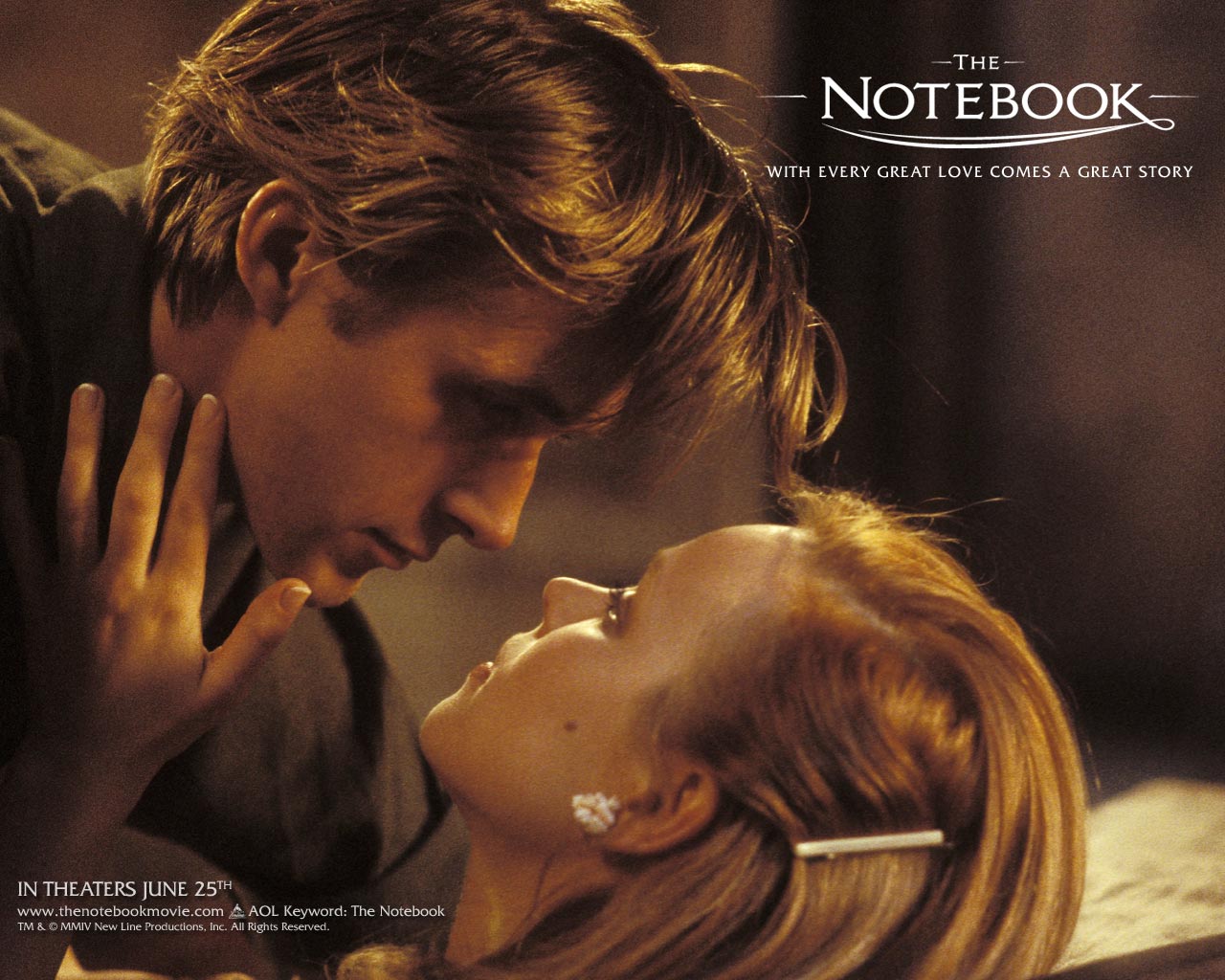
The Notebook (2004)


First off, I love the scenery, especially the opening sequence at the lake as the sun receded below the horizon, painting the sky crimson red. In slow motion, a man rows his boat on the lake, creating gentle ripples through the water with the red sky reflected off its surface. A flock of birds soar past the house as the camera moves in slowly, introducing Noah and Allie, portrayed by Ryan Gosling and Rachel McAdams.

Ever since they first met at the carnival, where Noah asked Allie out on a date in a rather unconventional manner, the two are absolutely crazy about each other despite their difference in social status. Taking place in the 1940's, as the idyllic summer in South Carolina comes to an end, Allie’s parents forbid her from seeing Noah. Years later, they are engaged in a love triangle, as Rachel must choose between a man from her past and her wealthy fiancé.

The lead characters have great chemistry and depth, engaging the audience in their impassioned story. They were able to reconnect like soul mates in spite of all the years of separation, showing how true love conquers all. I love how Noah fights to win her back, writing letters every day as he reminisces the sweet memories of the past, transitioning into the present time as he admires their renovated home that used to be the abandoned house where they spent the night together. One of my favorite parts is the scene when Noah leads her to a room overlooking the river with a canvas and paint brush waiting for her, just as she requested (It seems that Rachel McAdams is always painting in her movies). If there is anyone who knows her well, it’s Noah.

The Notebook is a well-crafted love story. I love that the director chose two actors who were relatively new to Hollywood. I couldn’t think of anyone one who could portray the roles better. The way the filmmakers pace the film was very gentle and slow, taking its time in a genuine, old-fashioned way. The swans were enchanting, but a bit over-the-top. The scene where they dance in the middle of the street in the still night seems foolish, but romantic. Several scenes featured in the novel by Nicholas Sparks were omitted; although, I believe the filmmakers made the right choice, as the film was already running at a two-hour duration.

However, the biggest flaw is including the scenes in present time. The fact that different actors portray the two main characters in their later years and the scenes have a different tone disrupts the flow of the story. Even though I dislike this second layer of storytelling, I must admit that it adds depth to the story. Nevertheless, I would prefer to focus on the story of Noah and Allie’s past.

Overall, The Notebook is always a classic love story about giving love a second chance.

Friday, June 22, 2012

Saturday, March 24, 2012

Eclipse (2012)


Eclipse is a subjective documentary.

Thanks to Incan Abraham, a psychedelic rock band, for the soundtrack.


Click here to watch

Thursday, March 1, 2012

Complicated (2012)

 
"Complicated" depicts a 'human mood ring', Jon, who tries to win Lena's heart through various bizarre costumes such as dragon and elephant suits.

This is my third comedy, in which I utilized the track dolly to capture the shots and various angles of a rustic courtyard that compliments the French soundtrack.

Friday, January 27, 2012

Mission Impossible: Ghost Protocol (2011)


Without doubt, Ghost Protocol is the best action film of 2011! It's very rare for the fourth film in a series to exceed it's predecessors.

Ghost Protocol has all the elements you could ask for in a pure adrenaline action film! The script was exceptionally written in the sense that there was a constant flow of action. The casting was right, the pacing was smooth, and the scene where Tom jumps off the tallest building in the world was mind-blowing! Apparently, Tom Cruise has no fear of heights since he executes most of his own stunts. When he said, "Go big or go home," he definitely meant it!

I'm glad that Jeremy Renner joined the IMF cast and it's no surprise that he's perfect for the role. Michael Nyqvist did a great job as the villain, contrary to his character as a detective in the swedish version of The Girl With the Dragon Tattoo. The fight between Paul Patton and Léa Seydoux was well choreographed. Benji, played by Simon Pegg, brought some comedic elements into the film such as:

Before Brandt jumps with the levitating metal suit:
Brandt "So I'm basically jumping into an oven"
Benji "Yes, but I'll catch you."

Leading up to the Burj Khalifa scene:
Benji "Okay, this is a slight wrinkle, but we'll have to go into the server room from the outside."
Ethan "We?"
Benji "Well I'm on the computer."

Referring to the gloves used to climb the side of the Burj Khalifa:
Benji "Remember, blue is glue."
Ethan "And red?"
Benji "Dead."

I love this film!

Friday, December 30, 2011

Ides of March (2011)


Ides of March is an intellectual film portraying the corrupt nature of politics. The plot is centered on Stephen Meyers (Ryan Gosling) who is one of the main staffers for presidential candidate Mike Morris (George Clooney). Stephen is on his way to a promising future in the White House until he reluctantly agrees to meet Tom Duffy (Paul Giamatti), the senior campaign manager of opposing candidate Pullman. This crucial mistake utterly sabotages his career as he appears to transform from an idealist strongly driven by morality to a corrupted politician as a result of vengeance.

I was immersed in this film in its entirety. You don't need to fully understand politics to enjoy Ides of March; although, it may be difficult to follow each character's motives for their actions. A second viewing would be ideal. I believe that the conclusion is open for interpretations as to whether Stephen has finally turned to corruption or has planned all along to expose Morris' wrongdoings.

In my opinion, Stephen ultimately keeps Morris' affairs discreet. First of all, he didn't need to attain the title of senior campaign manager through blackmail just to expose Morris. Ida (Marisa Tomei) would have gladly reported the story given adequate evidence despite Stephen being a "fired disgruntled employee." Secondly, it's possible that Stephen didn't have any evidence whatsoever and it was only his word against Morris'. Morris recognized that Molly's note could have been a bluff but didn't want to take chances. This is a legitimate decision considering the fact that impregnating an intern will, without doubt, ruin his chances of winning the campaign. Given this possibility, Stephen's accusation wouldn't bring any serious consequences without sufficient proof.

Ides of March has received some Oscar buzz. So far, it has received 4 Golden Globe nominations for Best Picture, Best Director (George Clooney), Best Actor (Ryan Gosling), and Best Screenplay. Leonardo DiCaprio, the executive producer of Ides, is an opposing Best Actor contender for his performance in J. Edgar.

The dialogue was brilliant and you must pay close attention in order to follow the plot. For a political thriller, this is a well-paced film with quick transitions between scenes. Personally, I thought it could have been 30 minutes longer.

Sunday, October 30, 2011

Split Seconds (2011)

Split Seconds is a short action film based on the theme of the Rashomon effect, which is defined as a representation of three different perspectives of the same event. In order to incorporate the Rashomon technique, I wanted each perspective to have a different style.

Because of legal constraints, production of some footage had to be brought in house through the usage of green screen. Keying and masking the green screen footage complicates reflections, shadows, and depth of field since the edges need to be fine tuned. Due to creative control, I will be handling chroma-key effects and concentrating on refining the gamma thresholds. This process will ensure that dominant objects will be preserved.

Action films are complex, so be prepared for the unexpected. Especially on the last day or the last scene, which, in this case, had to be connected seamlessly when both actors were filmed separately! This was particularly in the dialogues between Sean and Driver in the car.

"Split Seconds" is one of the most costly and challenging shorts I've ever made.


Watch Split Seconds on IMDb

Monday, July 11, 2011

Fight Club (1999)

Fight Club is a brilliant, classic film and has an outstandingly well-written script and exceptional execution by director David Fincher. The film adaptation stays true to the novel with a few exceptions including the conclusion and flows smoothly as the story progresses along with constant narration by the main character. You may think that this film is all about violence, but you must delve deeper.

Throughout the duration of the film, the insomniac protagonist’s name is never mentioned; thus, he’s known as The Narrator. There are several theories such as Jack but that is based on figurative statements. On a flight home from his monotonous job, he meets Tyler Durden, a “soap salesman”, who leads to the spread of Fight Clubs in numerous basements around the country and later resulting in Project: Mayhem.
There is only one part that drags but, overall, this is a very fast-paced film that keeps you entertained and the intensity rises as The Narrator ventures deeper into crime and oblivion. During one of the action scenes, The Narrator is thrown down the stairs. The stunt man had to fall down the stairs eleven times and they ended up using the first take! I love that part!


In addition to Helena Bonham Carter as Marla Singer, Edward Norton and Brad Pitt are perfectly casted as the two friends who start the Fight Club in order to channel anger and aggression as a unique therapy. In addition to Primal Fear, this is Edward Norton’s second movie where he portrays a character with multiple personalities. Only The Narrator is more complex.


If you have not seen Fight Club, don’t read any further. Sorry, but I must continue, I love this film! In truth, Tyler is the manipulative alter ego of The Narrator. The Narrator may appear as only a member of Project: Mayhem under the leadership of Tyler, but he is actually the boss who leads numerous acts of vandalism.


After watching it a second time, you discover the countless clues throughout the film that leads to the cryptic twist at the conclusion. These meticulous details are proof of the non-existence of Tyler. Here are a few examples. Approximately 5 single frames of Tyler Durden randomly flash in the background of several different scenes before his character actually appears on screen. It’s as if The Narrator has already developed Tyler in his mind but just hasn’t released him yet. Also, Marla is never in the same frame with The Narrator and Tyler. There are many more clues; you just have to keep your eyes open.


Saturday, May 28, 2011

Blue Rain (2011)

A man is haunted by a dark memory of his past as he's filled with guilt and must learn to forgive himself.
 
I've just been introduced to the concept of surrealism.

Maya Deren, a surrealist filmmaker, defined surrealism as being, "...concerned with the interior experience of the individual. It does not record an event which could be witnessed by others. Rather, it reproduces the way in which the subconscious of an individual develops, interprets and elaborates an apparently simple and casual incident (or series of incidents) into a critical emotional experience."

Surrealist version: YouTube


Blue Rain extended version (2012) is now on IMDb

Saturday, April 2, 2011

Aviator (2004)

This biographical film depicts the life of Howard Hughes, who is a successful filmmaker, creating numerous controversial films, and legendary aviator, accomplishing several world air-speed records throughout his lifetime. In addition, he is known to be one of the wealthiest men in the world.

Howard’s filmmaking career begins to prosper rapidly, receiving an Academy Award for his film Two Arabian Knights, which is the first time a comedy picture won the Best Director Award. Several of his high-budget films are Hell’s Angel, Scarface, and The Outlaw, which are large box-office success and claim to be highly controversial.

Being an icon in the 20th century, Howard Hughes has magnetized countless glamorous divas in Hollywood such as Billie Dove, Bette Davis, Ava Gardner, Olivia de Havilland, Katharine Hepburn, and Gene Tierney. But only one truly captures his heart. His relationship with Katharine Hepburn was well depicted in the film, which was adeptly portrayed by Cate Blanchett.

As an iconic industrialist and an aircraft enthusiast, Howard purchases the Transcontinental and Western Air, later known as the Trans World Airlines (TWA). He tests flies the H-1 Racer and sets a speed of 352mph, travels around the world in 91 hours also surpassing the previous record by nearly 4 days, and was also in the disastrous crash of the XF-11, sustaining numerous injuries such as a crushed collarbone and chest, 24 fractured ribs, one inflated lung, shifting the heart to the right side of the chest cavity, and several 3rd degree burns after his plane plummeted in several houses in Beverly Hills. Hughes was extremely lucky to survive after that near-fatal accident.

However, nothing could derail his vision. Howard Hughes, the most influential man in aviation history, is greatly known for building the H-1 Hercules, also known as the "Spruce Goose," is the largest, heaviest plane with the longest wingspan ever assembled in the world. This magnificent aircraft is currently in the Evergreen Aviation Museum in Oregon. However, this record was later exceeded by the Antonov 225 because, although the H-1 Hercules is still taller and wider, it is short and only covered a distance of 1 mile with Howard as the pilot while the An-225 has been flown farther distances and at a higher altitude.

After seeing such an outstanding film, Aviator definitely earned its 5 Oscars for Art Direction, Cinematography, Costume Design, Editing, and Supporting Actress. Leonardo did a superb job and is perfectly casted for the role. Martin Scorsese, as always, is a brilliant director and the cinematography is sensational.

Sunday, March 13, 2011

Shutter Island (2010)

This is a dark, mysterious thriller in which Teddy Daniels, perfectly portrayed by Leonardo DiCaprio, along with his partner Chuck Aule, characterized by Mark Ruffalo, investigates the puzzling disappearance of Rachel Solando from the Ashecliffe Hospital for the criminally insane, also known as Shutter Island. Both the novel by Dennis Lehane and the film adaptation by Martin Scorsese are equally superb. Scorsese is a master at keeping the audience glued to their seats, absorbed into the engrossing plot and chilled by the various frightening scenes hurtling at them. Despite its somewhat disturbing theme, Shutter Island has the rewatchability factor. Ironically, the movie’s title is an anagram for "Denials Truths."


HD Trailer

Wednesday, December 15, 2010

TriggerPoint (2010)

Sam becomes a victim of his own delusional game and is trapped within the cycle of his mind.
TriggerPoint is my second project for Advanced Video Production and is a combination of film noir and post-modernism. I was inspired to work on this project after watching Memento and Pi.
 Overall, it was a blast filming it.

WatchTriggerPoint
Official Site
Now on IMDb

Saturday, October 23, 2010

Dreamscape (2010)

Elena is trapped in her endless nightmare where escape seems futile.

Dreamscape is my first project for Advanced Video Production and is a short based on the theme of escape (moodscape). The narration was co-written with Ron Williamson. Time was a factor, as we tried to film all the forest scenes at magic hour on the first day.


Watch Dreamscape
Dreamscape official Site
Now on iMDB

Wednesday, May 12, 2010

A Beautiful Mind (2001)


A Beautiful Mind is a memorable biographical film that has won 4 well-deserved Academy Awards for Best Supporting Actress, Best Director, Best Picture, and Best Writer.

John Nash, portrayed convincingly by Russell Crowe, is an intellectual math prodigy who could solve the most mind-numbing problems that would bewilder even the greatest mathematicians and is a promising student at Princeton University. For his thesis paper, John is attempting to develop a truly original idea, resulting in a brilliant theory on mathematical economics.

Near the beginning, he admits that he is “better at numbers than people.” However, his unexpected roommate, Charles, is ultimately his best friend. Though he has several other influential acquaintances.

5 years later, he becomes a professor at MIT where John writes a complex problem on the board during calculus and challenges his students to solve it, stating that it would take the average student their whole lives to solve it and some would take a few months. However, no one was able to solve the complex problem, not even one of his most intellectual students, Alicia Larde, portrayed by Jennifer Connelly, whom he married later on.

One day, John meets William Parcher, a Department of Defense Agent who is represented by Ed Harris, and is asked to the Pentagon to decipher an intricate encryption. He remarkably solves it mentally, astounding the other code-breakers, which led him to being pursued by a black car and ever since then John became paranoid and behaves erratically. Alicia is under tremendous stress after realizing her husband is suffering from a mental disorder called schizophrenia. An interlude of hallucinations and delusional state of mind was enough to subject their marriage on a brink.

Eventually, John discovers that William Parcher and his best friend Charles never existed and they are all fragments of his distorted mind. Now, it is nearly impossible to determine who is real and who is a product of his delusional mind.

This film does an excellent job in depicting the brilliant and delusional life of John Nash, who is known for numerous significant discoveries such as the Nash Equilibrium and the game theory, earning him a Nobel Memorial Prize in Economic Science in 1996. In addition, it is truly inspirational and heartwarming watching John’s triumph over his lifelong battle against himself. “Nash. Who's winning - you, or you?”


Check out this equation just for fun!

Ck Embedding Theorem
If M= m-dimensional Riemannian manifold, then there is a number, n (n=m2 + 5m + 3)
Every point p of M, the derivative (dfp) is a linear map from the tangent space (TpM)
(u,v) = dfp(u) X dfp(v)
Partial Differential Equation (PDE)

A Gum's Life (2009) - Festivals


Wednesday, April 7, 2010

A Gum's Life (2009)


"A Gum's Life" has been screened in several Film Festivals:

2011 15th Annual North American All Youth Film and Education Day
2011 Soul 4 Reel Film Festival

2011 Los Angeles Student Media Festival
2010 Won The Kenneth and Harle Montgomery Prize Best Child Produced Film 27th Annual Chicago International Children's Film Festival
2010 Winner at International Student Media Festival in Anaheim
2010 Los Angeles Film Festival
2010 Reel Teens Film Festival in New York
2010 Sidewalk Moving Pictures Film Festival in Alabama
2010 Santa Cruz Film Festival California
2010 Cine Youth Film Festival in Chicago
2010 Made by Kids: ICA International Children's Film Festival Boston
2010 Newport Beach Film Festival California
2010 10th Annual deadCENTER Film Festival in Oklahoma
2010 Won the Audience Award at Screen Film Festival California
2010 NFFTY 2010 in Seattle
2010 ViewFinders International Film Festival for Youth in Canada
2009 Marlborough Film Festival California


"A Gum's Life" incorporates claymation, which is the process of altering the position of the clay characters after each frame.

Claymation is complex but as soon as we got the hang of it, we were cruising on our way to post. It is advantageous that nearly half of the film is animation and the other half takes place in the classroom.

In my opinion, the most time consuming part in filming this movie, is animating the characters' eyes. Between each frame, we had to change the position of the gums' pupils as well as carefully placing a thin piece of pink clay to make it seem as if they are blinking. The blue pupils were just a little bigger than the period at the end of this sentence. It took steady hands to stick each pupil on each of the gums' eyes. By the end of production, there were numerous blue pupils lying on the bottom of the pack of gum that were accidentally dropped during animation.

Watch it Now! or YouTube!